

Why can't you absorb more than ~90g of carbs per hour?
Your gut absorbs sugar through two separate doors — two different transport proteins built into the intestinal wall. Glucose uses one, called SGLT1; fructose uses another, called GLUT5. Because they're physically separate systems, each has its own independent speed limit.
SGLT1 can move about 60g of glucose per hour, no matter how much glucose you drink — it's an active, sodium-linked carrier that simply saturates at that rate. Drink only glucose gels or plain maltodextrin, and 60g/h is your hard ceiling — extra sugar just sits in your stomach and causes bloating or cramps.
GLUT5 handles fructose on a separate route, good for about another 30g per hour (see how to train your gut to raise your carb tolerance). Mix fructose into your carb source, and you're using both doors at once. That's why glucose-fructose blends push the realistic ceiling up to around 90g per hour.
This isn't just theory — it's been measured directly. Exercise physiologists track it with dual-tracer feeding trials, using labelled sugars to see how quickly ingested carbohydrate actually shows up as fuel being burned (exogenous carbohydrate oxidation). Research on combined glucose-fructose feeding (Jeukendrup, 2010) found that pairing carb sources that use different transporters — what he called "multiple transportable carbohydrates" — lets riders oxidize carbs roughly 50% faster than glucose alone — the ~60g/h vs ~90g/h gap described above (lab studies have measured up to ~105g/h).
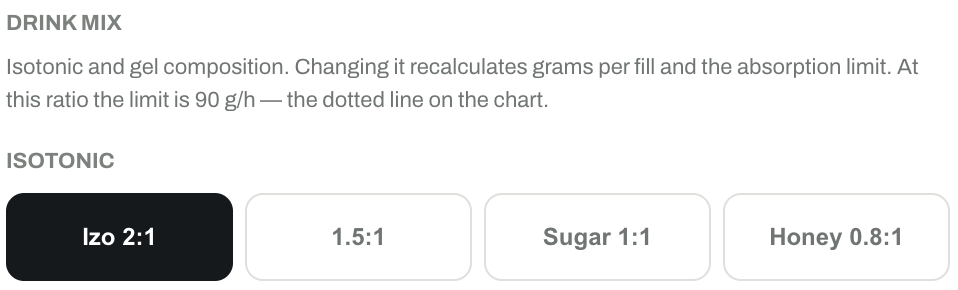
The ratio matters. Too much fructose and you waste the glucose door's capacity; too little and you waste the fructose door's. A 2:1 glucose-to-fructose ratio by weight is a good starting point for most riders — that's the default "Izo" mix in Carb Fueling.
Carb Fueling calculates your personal ceiling from the mix ratio you set, and shows it live as you change the mix.
Sources: Jeukendrup, Curr Opin Clin Nutr Metab Care 2010 (multiple transportable carbohydrates, oxidation up to ~105g/h).